
Planetary Blowback and the Era of Climate Fracturing
Introducing better terms to describe the reality of living on a heating planet


This summer, as Europe bakes in a heatwave, the Bugey nuclear power plant located on the banks of the Rhône River near Lyon has once again powered down.[1] [2] Bugey is one of four nuclear plants in France that use the river’s water to cool its reactors. But with water flow low and temperatures high, discharge of heated water is stopped or curtailed to protect river ecology, triggering a power down or shutdown.[3] [4] This example is one of many that illustrates how climate change undermines critical infrastructure with knock on effects for economic systems. Yet, the terms used in the climate space fail to sufficiently describe these impacts and the reality of life on a warming planet.
That’s why the ideas expressed by economist James Meadway feel prescient. In his writings and excellent podcast Macrodose, Meadway posits that environmental degradation and climate change are blowback from centuries of industrial capitalism that are gradually undermining hitherto reliable infrastructure and economic systems, manifesting as a slow grind of life becoming harder and costlier. This has already begun with, predictably, societies’ most vulnerable and the world’s poor feeling the impacts first and hardest. Building upon Corey Doctorow’s theory of the decline of internet platforms, Meadway names this decline and new economic order the “enshitiffication of everything”.
Terms matter. The images they conjure and emotions they instil in us inform how we make sense of the world and perceive threats. While “enshittification of everything” is a striking hook, on closer examination it feels somewhat reductive and misused. Crucially, it feels like a missed opportunity to convey compelling ideas and coin a more fitting and distinct term to fill a gap in the climate space. As a first draft, this essay proposes the terms Planetary Blowback and the Era of Climate Fracturing be considered.
In what follows, we’ll examine limitations among existing terms in the climate space, summarize Doctorow’s theory of platform enshittification and discuss Meadway’s ideas in more detail, culminating in an assessment of the suitability of “enshittification of everything”. We’ll finish by proposing that Planetary Blowback and the Era of Climate Fracturing better names the emerging economic order Meadway describes.
A Gap in a Cluttered Landscape
There is an abundance of climate terms, which is perhaps unsurprising as language has been a key front in the various political battles surrounding climate. In an infamous 2002 memo, communications consultant Frank Luntz advised Republicans use the “less frightening” term “climate change” over “global warming”, given the latter’s “catastrophic connotations”[5][6]. On the other end of the spectrum in 2019, The Guardian published an updated vocabulary to inform its environmental reporting.[7] Noting that climate change sounded “passive and gentle” the guidance recommended privileging global heating, climate crisis, climate emergency or climate breakdown. While an improvement, particularly in how the latter terms move beyond descriptive scientific language to centre warming temperatures’ impact on human societies, none of these terms feel entirely accurate in describing the reality of life on a heating planet.
Whereas crisis, disruption, emergency or breakdown imply something immediate, short-lived and even apocalyptic, the impacts of climate change are more insidious and pernicious. To be clear, extreme weather events are deadly and there is a real possibility for global and catastrophic outcomes, triggered by feedback loops. However, impacts will largely be felt over decades to centuries such that most people will experience environmental degradation and climate change as a progressive grind of life becoming harder and eventually, even impossible. There will be periods of crisis, namely from extreme weather events, but these will either pass or gradually become accepted as part of life, which will continue, albeit with greater difficulty.
In more consultant-corporate-regulatory speak, such as the CSRD[8], climate impacts are conceived primarily in terms of risk. These are broadly separated into transition risks (e.g. the threat of stranded assets from a changing regulatory landscape) and physical risk, both acute and chronic. As the name suggests, acute risks are short term, such as a storm surge following a hurricane, whereas chronic risks are longer term, such as sea-level rise. While helpful in identifying and assessing specific challenges, these dry and wonkish terms fail to capture the bigger drivers at play nor explain how climate impacts play out at a systemic level. Crucially, they are hardly relatable to a wider audience and fail to cut through to peoples lived experiences.
Elsewhere, some use the term climate instability to convey the destabilizing force of climate impacts. But this term focuses unduly on extreme weather and implies fluctuations, thus minimizing the trend of warming temperatures. At a higher-level, terms have tried to capture the general urgency of our time and conflation of multiple challenges. Notably, and in-keeping with the crisis centric theme, the term polycrisis was ubiquitous in Davos in 2023, capturing how challenges from climate to war to inflation are compounding one another, creating an era characterized by crisis. However, this vague term isn’t helpful either as it fails to identify the main drivers[9] and perhaps overstates the extent to which crises compound one another.[10]
In the universe of terms, there is therefore a gap for a clear, accurate and accessible term to describe how climate change will be felt for most people. Meadway’s ideas fill this gap but the term “enshittification of everything” feels wanting. Before discussing Meadway’s ideas in detail, it is first worth examining the original term.
Decline Online: the Enshittification of Platforms
The simple and vulgar word en-shit-iffication (i.e. to become shit) has its origins in cyberspace. It was coined by internet activist and influential blogger Corey Doctorow in 2022 to describe the process in which digital platforms decay. It evidently tapped into the zeitgeist as it was named word of the year in 2024 by Australia’s Macquarie Dictionary, with the committee noting “the word captures what many of us feel is happening to the world and to so many aspects of our lives at the moment”.
While Doctorow doesn’t appear too precious about how the term is used, accepting it can also describe a general deterioration; it is formally defined as:
“the gradual deterioration of a service or product brought about by a reduction in the quality of service provided, especially of an online platform, and as a consequence of profit-seeking.”[11]
When coining enshittification, Doctorow described an intentional strategy of rent seeking for shareholder value, which worsens online platforms. He identifies four simple steps. First platforms are good to their users to obtain a dominant quasi monopoly position, cemented through network effects. Second, they abuse their users for their business customers. Third, they abuse business customers to claw back value for themselves. Fourth and finally, they die.[12]
People have argued that enshittification has played out in platforms from Uber[13] to Airbnb[14] but the classic example is Facebook, who infamously sold customer data to advertisers resulting in cheapened newsfeeds and user experience. The theory is compelling as it explains how rent-seeking has undermined so much of the internet and how curbing platform’s power can help stop this process. But is the application to the environment and economics entirely fitting?

Enshittification of Everything: from Cyberspace to the Real World
Borrowing from Doctorow and building upon Marxist economists like Michael Kidron,[15] Meadway argues that the climate and nature crises represent the “enshittification of everything”. Roughly, the argument is that centuries of industrial capitalism have created an economy characterized by ever falling costs. The bill for this era has now come in the form of environmental degradation, which is inflicting economic cost and undermining growth, thereby creating a new economic order.[16]
In Meadway’s words:
“The emerging economic order can be summarised quickly: we have moved from a world of falling costs to one of rising costs. The capacity of the planet’s natural systems to absorb costs on behalf of humanity – whether soaking up greenhouse gases, or providing consistent new sources of raw materials has been exhausted. We are living through the period of blowback (my emphasis added), of the great reversion of the last two centuries of industrial capitalism – and further, into the centuries of colonial plunder that provided the basis for the development of a global market that achieved its apogee in the decade before 2008. “Enshittification” occurs when the drive to create cheap runs into rising real costs.” [17]
The idea applies to all manner of environmental degradation but it is powerfully illustrated by climate change. The past 11,700 years were a remarkably stable climatic era, known as the Holocene. While regional temperature variations existed, conditions were overwhelmingly stable allowing human civilization to emerge and evolve.[18]
Humanity’s economic and social systems, infrastructure and cultures were formed by and built for this era. Agricultural systems were designed around predictable seasons and patterns of precipitation, cities gradually developed for a particular temperature range, regular rainfall provided an ample supply of water for the Panama Canal, insurance premiums were designed around manageable risk thresholds, etc.
Yet, by substantially increasing the concentration of greenhouse gases in the atmosphere, humanity is pushing the global climate system into a new era, to which human infrastructure and societies are maladapted.
Consequently, things that were mostly reliable stop working as well. For instance, crop yields decline in the face of drought,[19] cities become ovens in heatwaves,[20] traffic backs-up on the Panama Canal[21] and entire regions become more vulnerable to natural hazards.[22]
The basic manifestation of this maladaptation is growing scarcity, decreased productivity and rising cost. To quote Meadway:
“What climate change threatens mostly isn’t some final Don’t Look Up style cataclysm… but the enshittification of everything, day-to-day things will cost more, fail more often, and not work in the ways we have become accustomed to.”[23]
In practice this might look like the price of food increasing with knock-on effects for the cost of living,[24] healthcare costs rising during heatwaves stretching already strained public budgets,[25] the cost of shipping surging creating disruption to global supply chains[26] and insurance premiums rocketing or being removed for entire regions, with serious repercussions for the financial system.[27]
Crucially, cost increases aren’t always linear or permanent, and rarely is climate the only factor at play. But the general trend is that life becomes harder and costs generally rise as systems designed for a previous era struggle to perform as well in harsher conditions.
These claims are of course contested. Someone with an ecomodernist or techno-optimist tilt might argue that the economic risks of climate change are overstated, and that there is ample scope for adaptation or at least buffering to absorb any cost rises.
Addressing these points is beyond the scope of this essay. Nonetheless, it’s worth emphasising that climate change is only at its beginnings. Further warming and worsening impacts are coming. In addition, the scale of the challenge is enormous and compounded by infrastructure lock-in. Adaptation requires innovation, investment, behavioural change and time. Given the lack of political ambition and the escalating pace of impacts, it’s difficult to foresee how adapting the world’s physical infrastructure, economic and social systems can credibly keep up with the impacts of climate change and environmental degradation.[28]
A Powerful Hook, but an Imperfect Fit
These ideas are compelling but it feels like the “enshittification of everything” is used more for convenience and as a rhetorical hook than as a deliberate, conscious term.
In his theory, Doctorow describes an intentional strategy of rent seeking for shareholder value that results in the decline of a product or service. By comparison, Meadway describes the systemic consequences of industrial capitalism and how environmental degradation will and is impacting virtually every aspect of the economy. They are thus describing quite different things, such that bolting “everything” at the end feels insufficient.
In addition, Meadway’s use of enshittification feels inaccurate. Platform decay occurs in tandem with ever rising profits such that enshittification for users is enrichment (or enrichification)[29] for shareholders. As long as users remain users, all is well. However, this strategy differs from the premise that environmental degradation will make economic growth harder to achieve.
While the enshitiffication of everything is memorable and striking, it feels reductive. At face value, it sounds like things just getting worse, which feels like an understatement. It also fails to name the causes of decline. Finally, it’s likely the term will forever be synonymous with the internet, making it unlikely that an ascribed new meaning will catch on.
Planetary Blowback and the Era of Climate Fracturing
Different terms could therefore better describe the ideas encompassed by “the enshittification of everything”. In the below table, I introduce the terms Planetary Blowback and the Era of Climate Fracturing.[30] These terms are very much a first draft, in which I hope others will find value.
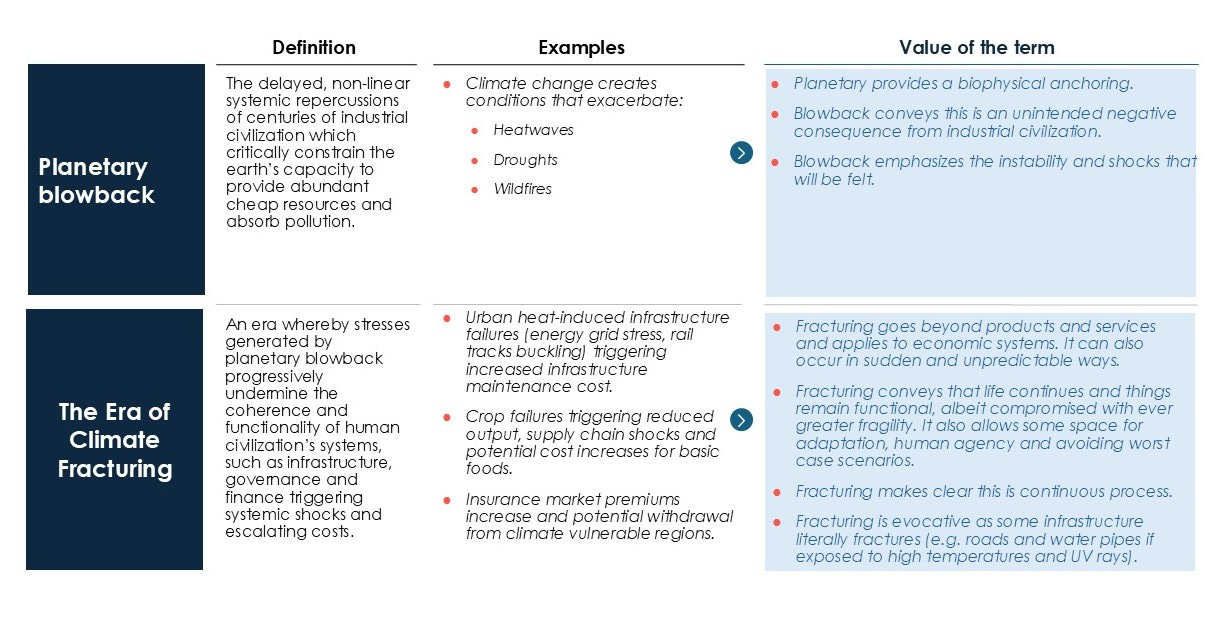
A common frustration for many in the environment space is the extent to which the reality of environmental degradation and climate change are misunderstood. Too many people in affluent countries regard environmental issues as something distant that will affect their descendants or people elsewhere. Even when their lives are impacted directly, the link is not as clear as it should be.
While climate change is far from gentle as the name might suggest, nor does humanity appear in danger of imminent extinction. They are better conceived as pernicious threats that will create economic fragilities and become the dominant force in the 21st Century.
The terms Planetary Blowback and The Era of Climate Fracturing could better name this reality and help foster greater understanding of the underlying drivers, as critical infrastructure and systems become fractured and even break. It could also contribute to a better understanding of the real life consequences and the extent of societies’ vulnerabilities.
Planetary Blowback is creating a new Era of Climate Fracturing. A clear understanding and term can name this reality so that a more resilient economy can emerge for a harsher, fractured century.
[1]https://fr.euronews.com/2025/07/03/danger-aigu-du-a-la-chaleur-la-france-et-la-suisse-arretent-les-centrales-nucleaires
[2]https://actu.fr/auvergne-rhone-alpes/amberieu-en-bugey_01004/canicule-le-rhone-est-trop-chaud-edf-va-baisser-l-activite-de-la-centrale-nucleaire-du-bugey_62798895.html
[3]https://www.carbonbrief.org/guest-post-how-global-warming-is-making-power-plants-produce-less-electricity/
[4]https://www.wired.com/story/nuclear-power-plants-struggling-to-stay-cool/
[5]https://www.the-republican-reversal.com/uploads/1/2/0/2/120201024/luntzresearch.memo2.pdf
[6]Luntz has since admitted he was wrong on climate change[6] an admission that is supported by the best available science.
[7]https://www.theguardian.com/environment/2019/oct/16/guardian-language-changes-climate-environment
[8]https://finance.ec.europa.eu/capital-markets-union-and-financial-markets/company-reporting-and-auditing/company-reporting/corporate-sustainability-reporting_en
[9]https://www.vox.com/23572710/polycrisis-davos-history-climate-russia-ukraine-inflation

[11]https://www.macquariedictionary.com.au/word-of-the-year/word-of-the-year-2024/
[12]https://www.ft.com/content/6fb1602d-a08b-4a8c-bac0-047b7d64aba5?utm_medium=email&utm_source=topic+optin&utm_campaign=awareness&utm_content=20240510+econ+nl
[13]https://www.prospectmagazine.co.uk/ideas/technology/63324/how-weve-enshittified-the-tech-economy
[14]https://jacobin.com/2024/01/airbnb-big-tech-hotels-travel-sharing-economy-capitalism
[15]https://www.marxists.org/archive/kidron/works/2002/xx/ghosts.htm
[17]https://ebooks.uni-lj.si/ZalozbaUL/catalog/download/642/1016/10667?inline=1
[18]https://www.carbonbrief.org/global-extent-of-climate-change-is-unparalleled-in-past-2000-years/
[19]https://www.pnas.org/doi/abs/10.1073/pnas.2502789122
[20]https://education.nationalgeographic.org/resource/urban-heat-island/
[22]https://www.unepfi.org/wordpress/wp-content/uploads/2023/03/Real-Estate-Sector-Risks-Briefing.pdf
[24]https://www.carbonbrief.org/five-charts-how-climate-change-is-driving-up-food-prices-around-the-world/
[25]https://www.americanprogress.org/article/the-health-care-costs-of-extreme-heat/
[26]https://www.current-intl.com/blog/drought-in-the-panama-canal-and-its-effects-on-global-shipping/
[27]https://www.ft.com/content/9e5df375-650d-492e-ba51-fb5a34e6ddd6
[29]En-rich-iffication.
[30]At first glance, one might feel the Era of Climate Fracturing places overdue emphasis on climate. Yet, as mentioned climate change marks a departure from the Holocene and a new climatic era for humanity. Moreover, climate change is a leading environmental issue that compounds many other challenges, making it apt to emphasise climate.